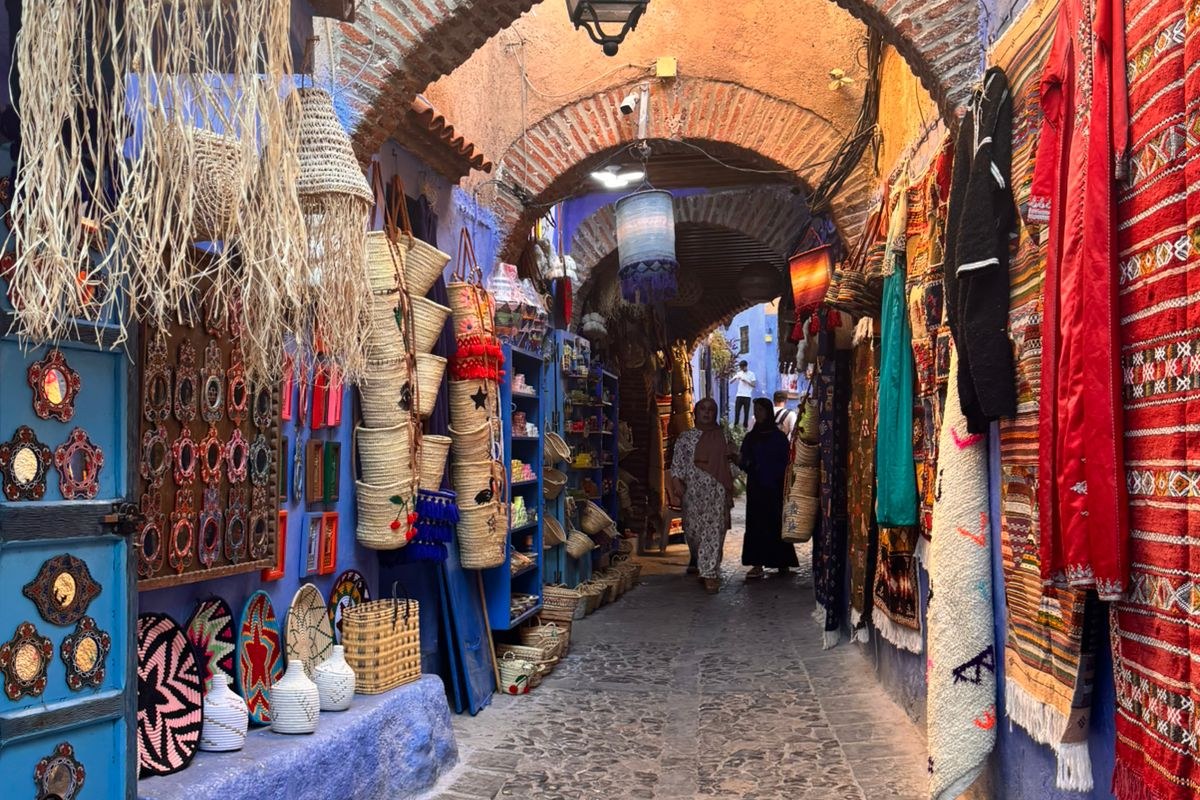
Six in the morning. The sky above the medina is the particular blue that comes just before the sun clears the Atlas, a shade that has no name in any language I have found. The call to prayer has finished. The city is in the brief pause between devotion and commerce, and in that pause it shows you something it will not show again until tomorrow.
I have walked these streets for years. I grew up knowing them the way you know a house you have lived in since childhood — by feel, by sound, by the particular way the light falls through a certain archway at a certain hour. But even now, at six in the morning, the medina surprises me.
The derbs — the narrow private lanes that branch off the main arteries — are empty. Not quiet. Empty. There is a difference. Quiet suggests the absence of sound. Empty is the absence of performance. The medina at six in the morning is not performing for anyone. It is simply itself.
A man in a djellaba moves through the Rahba Kedima carrying a tray of bread on his head, balanced with the particular ease of someone who has never had to think about it. The bread is for a family nearby — a regular delivery, a small commerce that has been running the same route since before anyone alive can remember. He nods at me without breaking stride. We have seen each other here before.
The spice souk is shuttered, the wooden stalls locked with padlocks that look older than the hinges they hang from. But the smell is fully present — cumin, dried rose petals, ras el hanout in its fifty possible variations. Smell travels ahead of sight in the medina. You know where you are before you see it.
At the entrance to the leather souk, a cat sits on a stack of folded hides. It regards me with the particular contempt of an animal that understands it belongs here more completely than I do. It is correct.
The thing about the medina at six is this: it gives you back the city's actual proportions. Later — by nine, certainly by ten — the lanes will compress. Not physically. The walls do not move. But the presence of other people, the vendors and the tourists and the motorcycles that somehow navigate passages barely wide enough for a bicycle, creates a kind of spatial pressure that changes how the place feels. You lose your sense of where you are. The medina becomes a maze.
At six, it is not a maze. It is a neighborhood. You can feel the logic of it — the way the dyers' quarter sits downwind from the weavers, the way the food stalls cluster near the mosques because the morning congregation needed to eat, the way the street widens exactly where a family compound once had gates that have long since disappeared. The city's history is legible in its shape. You just need the quiet to read it.
I have walked visitors through the medina at this hour and watched something shift in them within the first ten minutes. The defenses that travel installs — the wariness, the constant orientation, the mental map-checking — begin to fall away. They stop looking for landmarks and start looking at things. A carved stucco panel above a door. The geometry of a zellige threshold, worn smooth by five hundred years of feet. A boy carrying a cage of pigeons toward the market, moving with the purposeful ease of someone on a known errand in a familiar world.
This is the version of Marrakech worth finding.
Most itineraries do not make room for it. The morning schedule fills: breakfast, riad checkout, airport transfer, or the day's activities beginning at nine when the sites open. The medina at six is left for the people who live there.
I understand why. Travel has its rhythms, and most of those rhythms are organized around the hours of commerce. The souks open when the souks open. The museums have their hours. The hammams are not ready until noon. Early morning, in most itineraries, is simply transit time.
But the medina at six is not a sight. It is not an activity. It is an orientation — a way of understanding what you are actually standing inside when you walk into this city. Without it, the medina remains a spectacle. A beautiful, overwhelming, exhausting spectacle that you are always slightly outside of.
With it, something else becomes possible. You begin to understand the place from the inside rather than from the position of the observer. And that understanding does not leave. It changes every other hour you spend here.
I was walking through the Mouassine neighborhood last spring at this hour when I heard, from behind a studded door I had passed hundreds of times, the sound of a woman singing. Not performing. Singing the way people sing when they believe no one is listening — fully, without restraint, with the particular freedom of private sound. The song was in Tachelhit, a Berber language from the south. I stood still for longer than I should have. Then I walked on.
I have not told many people about that moment. It belongs to the category of things the city offers only to those who are present at the right time, in the right condition of attention. The medina has thousands of these moments. They do not repeat.
What I tell people instead is this: if you are coming to Marrakech, arrange one morning — just one — to be in the medina at six. Do not plan what you will see. Do not hire a guide. Walk in from Bab Doukkala or the Jemaa el-Fna and follow whatever draws you. The streets will not make sense at first. That is correct. Stay with it.
At some point in the first hour, the city will stop being foreign. That is the moment worth coming for.